Whole-of-Market Serviced Accommodation Mortgage Advice
Serviced accommodation, the short-let or flexible-stay model, used to be a niche add-on to buy-to-let. Not any more. A well-run unit can out-earn a standard tenancy comfortably, which is why landlords keep asking about it.
Most high street lenders simply won’t fund it, and the handful of specialists who will apply rules that catch people off guard if they’re expecting an ordinary buy-to-let process. What follows is a practical look at how serviced accommodation is actually financed: the underwriting, the lender pool, the licensing rules, and when another structure might suit a property better.
What Is Serviced Accommodation Finance?
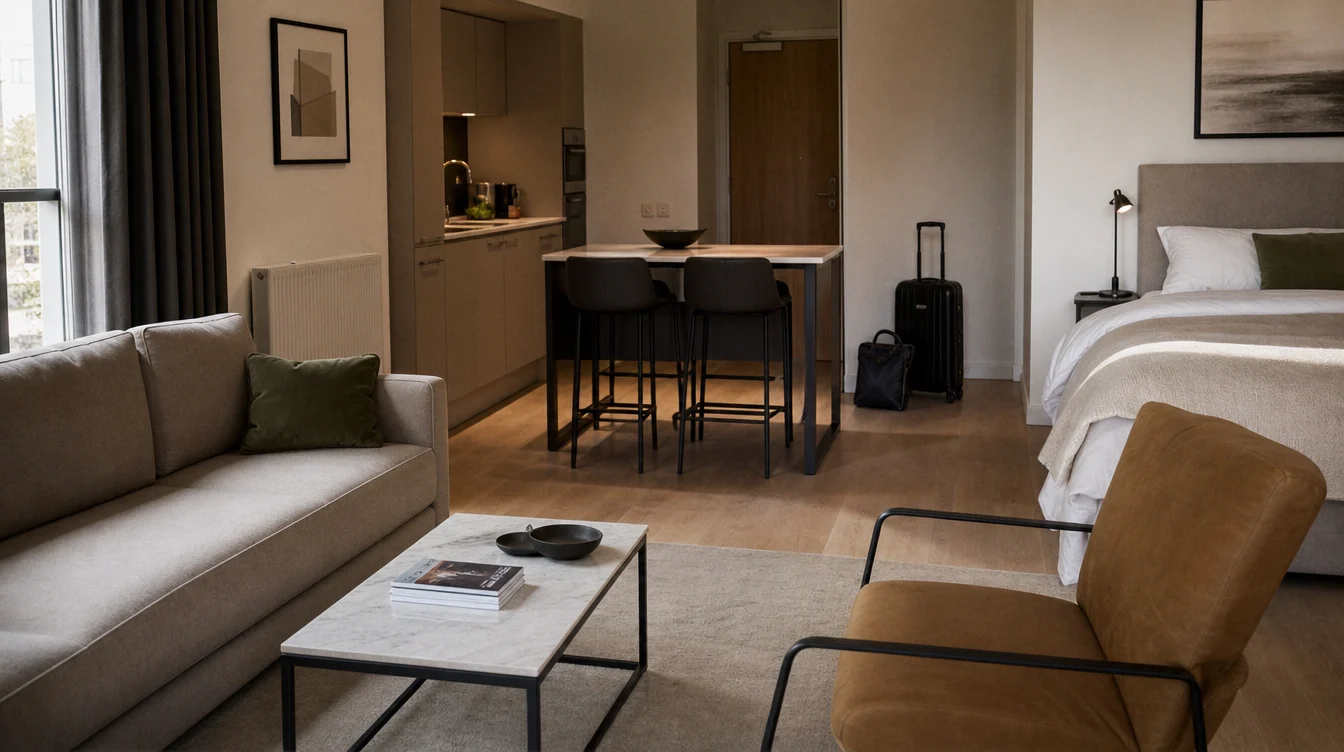
Serviced accommodation means letting a self-contained property on a short, flexible basis, not under a standard tenancy agreement. The typical guest is a contractor, a relocating professional or a business traveller, not a holidaymaker, which is the real difference from an ordinary holiday let.
A single flat let this way usually just needs a residential mortgage product whose terms expressly allow short-term letting, because standard buy-to-let agreements rule it out entirely. Our serviced accommodation finance page covers how we place these deals across the panel. What follows here is more about the underwriting itself, and about matching the model to the right property.
Multiple units, a block of flats or an aparthotel-style operation sit in commercial mortgage territory instead, underwritten against the business rather than a single tenancy. Bridging finance comes into the picture too.
A typical serviced accommodation purchase starts as a fast acquisition of a property that isn’t yet lettable, gets brought up to standard through refurbishment, and is then refinanced onto a longer-term serviced accommodation mortgage once it’s trading. Plenty of landlords get into the sector this exact way.
How Lenders Assess a Serviced Accommodation Application
What catches most landlords off guard is the income test itself. Specialist lenders typically base affordability on the property’s long-term market rent under a standard tenancy, as confirmed by their own valuer, not on the nightly rates or occupancy levels an operator is actually achieving. The loan amount follows that lower, standard-tenancy figure, even where the real trading income comfortably exceeds it.
On top of that market-rent figure sits an interest cover ratio, usually 125% for limited company borrowers and basic-rate taxpayers, climbing to somewhere around 140% to 145% for higher-rate individual borrowers. This is tested against a stressed rate rather than the actual pay rate on the deal, typically the five-year fixed pay rate, with shorter-term products carrying an added margin and a floor around 5% to 5.5%.
A single residential unit through the specialist buy-to-let market usually needs a deposit of roughly 25%, putting the maximum loan to value at around 75%. Multi-unit or aparthotel structures financed commercially sit lower still, broadly 65% to 70% loan to value, since lenders price in the extra risk of underwriting a trading business rather than one tenancy.
Because the affordability test rests on standard market rent rather than short-let income, the figures on paper often look tighter than the property’s actual trading performance. We check the numbers against each lender’s own method before a case is submitted, so there’s nothing unexpected waiting at valuation.

Who Can Get a Serviced Accommodation Mortgage?
Serviced accommodation falls outside the standard buy-to-let box, so the pool of willing lenders is smaller and some ask for more than a straightforward BTL case would. A number insist on an existing property portfolio before they’ll consider a first serviced accommodation unit; others are open to a first-time landlord provided the rest of the case is strong.
Lenders here tend to look more closely at a clean track record, with no mortgage arrears over at least the past three years usually expected, and borrower age sits within the usual mortgage bands: typically a minimum of 21 to 25, rising to 70 or 80 as the oldest age permitted at the end of the term.
None of this is set in stone. It comes down to the lender, the property, and how strong the application is overall, which is exactly why a whole-of-market approach counts for more here than on an ordinary buy-to-let case.
Licensing, Planning and Use Class
A single property let as serviced accommodation usually stays within standard residential use and needs no separate planning consent. Running several units together, or operating more like a small aparthotel, can shift the building into a different use category that some councils choose to examine.
Short-let licensing rules differ significantly from one part of the UK to another. Scotland has required a licence for short-term lets since 2022. England and Wales are both building towards a national short-let register, expected to be fully running by spring 2027. London applies its own 90-night annual cap on letting a whole property short-term without separate planning permission.
Leasehold flats bring a further check. Plenty of leases cap subletting at six months or more, which can block a short-let model outright unless the freeholder is willing to agree otherwise. This is worth confirming ahead of a purchase, not after one.
If Serviced Accommodation Isn’t Right for You: The HMO Alternative
Serviced accommodation isn’t the only way to push income above a standard single let. Renting by the room through an HMO structure is the other established route, suited to a different type of property and a different level of hands-on management.
Financing an HMO tends to be more straightforward: a wider pool of lenders, deposits from around 25% and loan to value up to 75% or 80% with some specialist lenders. The trade-off is a dedicated licensing regime and considerably more tenants to manage day to day.
Serviced accommodation runs the opposite way: fewer, higher-paying short stays, a narrower lender pool, and a hands-on operating style much closer to hospitality than landlording. Our HMO finance page explains how that lending works for anyone whose property, or whose appetite for day-to-day management, points towards an HMO instead.
Serviced Accommodation vs Buy-to-Let vs HMO: The Short Version
| Feature | Standard buy-to-let | HMO | Serviced accommodation |
|---|---|---|---|
| Income basis | Market rent, one tenancy. | Market rent, assessed room by room. | Long-let market rent, not nightly rate or occupancy. |
| Typical deposit and loan to value | 20% to 25% deposit, up to 75% to 80% loan to value. | 25% or more deposit, up to 75% to 80% loan to value. | 25% or more for a single unit, up to around 75% loan to value; 65% to 70% for a commercial multi-unit structure. |
| Lender pool | Widest, high street names included. | Narrower, still a broad specialist panel. | Narrowest, limited to lenders whose terms explicitly permit short-term letting. |
| Licensing and planning | None beyond the tenancy itself. | Licence required, can trigger Article 4 restrictions in some areas. | Varies by nation and council; single units generally stay in standard residential use, multi-unit operations face closer planning scrutiny. |
Frequently Asked Questions
How is income assessed for a serviced accommodation mortgage?
Specialist lenders base affordability on the property’s long-term market rent under a standard tenancy, as confirmed by their own valuer, rather than on nightly rates or occupancy.
The loan amount follows that standard-tenancy figure even when the real short-let income is considerably higher.
How big a deposit do I need for a serviced accommodation mortgage?
A single residential unit financed through the specialist buy-to-let market usually needs a deposit of around 25%, putting the maximum loan to value near 75%.
Multi-unit or aparthotel structures financed commercially sit lower, broadly 65% to 70% loan to value.
Do I need experience as a landlord to get serviced accommodation finance?
Not necessarily.
Some lenders want an existing portfolio before taking on a first serviced accommodation case, while others will consider a first-time landlord provided the credit history and the rest of the application are strong.
Do I need planning permission to run a property as serviced accommodation?
A single unit generally stays within standard residential use and needs no separate planning permission.
Running several units together, or an aparthotel-style operation, can draw planning scrutiny, and short-let licensing requirements differ from one council to the next regardless of planning status.
What if serviced accommodation turns out not to be the right fit for a property?
An HMO is the other well-established way to lift income above a standard single let, with a wider lender pool but its own licensing regime and more tenants to manage directly.
The right choice comes down to the property and how hands-on you want to be running it.

Speak to a Commercial Finance Specialist
Serviced accommodation sits somewhere between standard buy-to-let and full commercial lending, and the lender quoting the sharpest rate on paper isn’t always the one whose underwriting actually matches how the property is run day to day. As a whole-of-market commercial finance broker we can confirm which lenders are likely to engage with your serviced accommodation deal, what loan to value and rate to expect, and whether the property is better suited to serviced accommodation, an HMO structure or a commercial facility, before anything goes to a lender.
Commercial Finance Network is directly authorised and regulated by the Financial Conduct Authority.
Buy-to-let and other business finance is not regulated by the Financial Conduct Authority. Your property may be repossessed if you do not keep up repayments on a loan secured against it.
Call us on 03303 112 646 / 01494 622 111 or email info@cfnuk.com to speak to a specialist directly.
Related Pages
- Commercial mortgages – How we place commercial mortgages, the route used for larger serviced accommodation portfolios and aparthotel-style structures.
- Refurbishment loans – Short-term finance to bring a property up to the standard a serviced accommodation letting needs before it goes on the market.
- HMO remortgages – How to refinance an HMO already in your portfolio onto a longer-term rate.
- Commercial mortgage calculator – Check indicative costs for a multi-unit or commercial serviced accommodation structure.
- Contact us – Send us the outline of your deal for an indication of terms.